Ideas
Back to all appearances
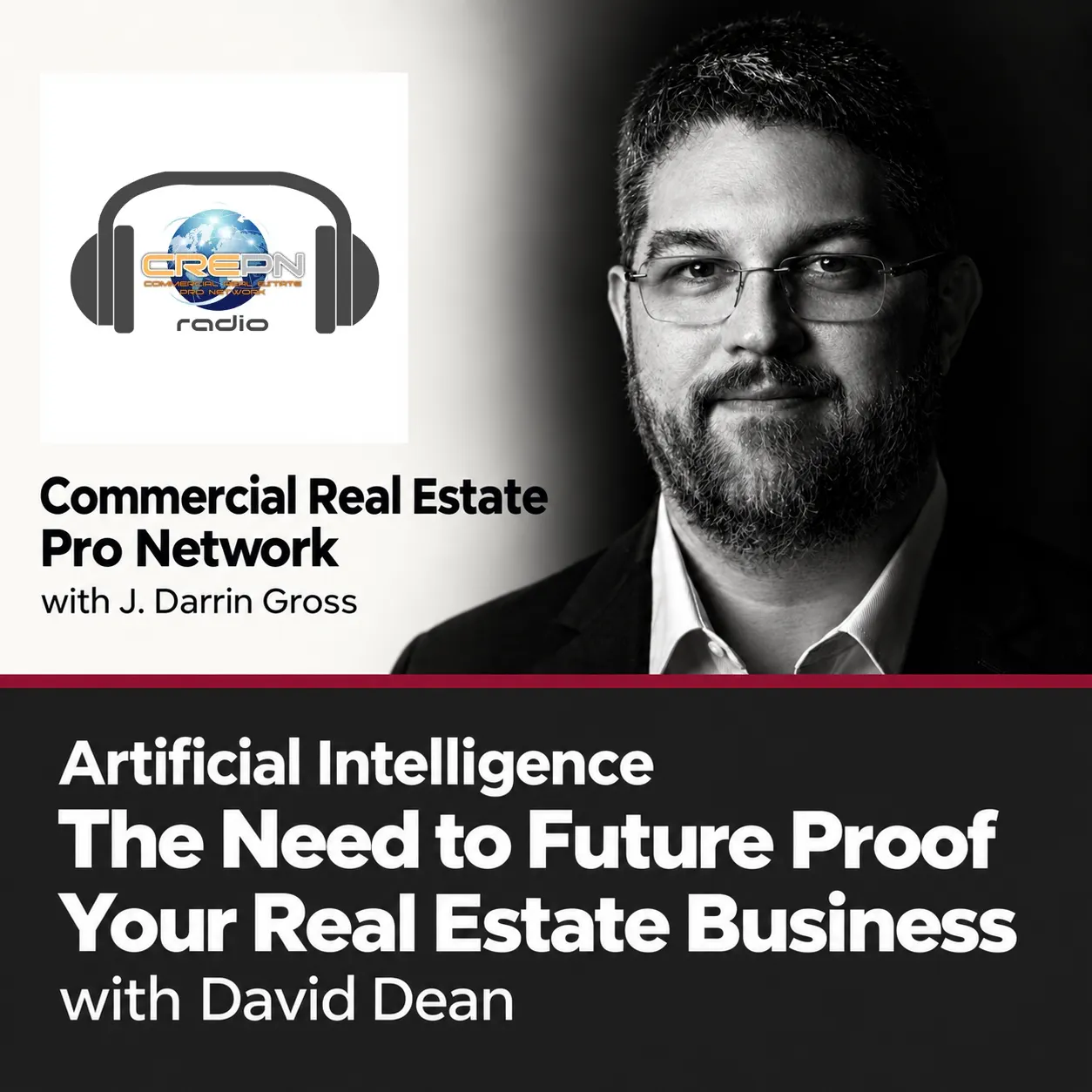
Commercial Real Estate Pro Network with J. Darrin Gross
Artificial Intelligence The Need to Future Proof Your Real Estate Business with David Dean
Hosted by J. Darrin Gross
Artificial intelligence is changing how organizations analyze information, make decisions, manage risk, and compete—but successful adoption requires more than simply giving employees access to AI tools.
Original episode
Listen or watch
Conversation summary
Artificial intelligence is changing how organizations analyze information, make decisions, manage risk, and compete—but successful adoption requires more than simply giving employees access to AI tools.
In this episode of Commercial Real Estate Pro Network, host J. Darrin Gross speaks with author, speaker, technical architect, and business AI realist David Dean about what business leaders and commercial real estate professionals should understand as AI becomes increasingly embedded in how work gets done.
David explains why AI is better viewed as an augmentation of human judgment than a replacement for it. AI can analyze data, identify patterns, compare scenarios, and surface signals, but accountability, experience, context, and understanding downstream consequences still belong to people.
They explore how commercial real estate investors can use trusted data and AI to evaluate opportunities, test scenarios, and uncover insights, while avoiding the risks of making decisions from incomplete or poorly understood information.
The conversation also examines AI security, governance, behavioral data, and one of the largest risks facing organizations: not fully understanding how their own work actually gets done. Future-proofing the business starts with understanding the people, processes, data, and undocumented behaviors behind the organization before deciding what should be automated, augmented, or changed.
Key insights
- David frames generative AI as a way to assemble information into stories people can examine and act on. The person using the output still owns the decision.
- Scalable, reusable AI solutions take time, effort, and an understanding of the work. Access to a tool does not supply that understanding.
- Darrin connects the discussion to the data investors use to evaluate properties. David emphasizes establishing reliable sources and a trusted baseline before asking AI to explore scenarios.
- Numbers need context: how a business defines a term, what is happening around a property, and what experienced people know can change the interpretation.
- An exported spreadsheet can offer useful material for exploration while leaving important information out. David asks decision makers to validate the interpretation before acting on it.
- Public interviews, articles, and other communications can reveal patterns in how people and organizations behave. David discusses both the learning opportunities and the potential for misuse.
- David identifies a lack of organizational self-understanding as the biggest risk: leaders can make consequential decisions with only part of the picture.
Questions answered
Where does David suggest beginning with AI-assisted analysis?
Establish a baseline of reliable, verifiable data and understand where it comes from. Different sources each tell part of the story. David then describes bringing that information together with business definitions and contextual knowledge before using AI to explore what-if scenarios.
What does human experience add to an investment decision?
David asks listeners to imagine an experienced investor visiting a property. What the investor notices and how they interpret it draws on prior decisions and their consequences. AI can help surface information, but the investor still has to judge what it means in that situation.
Why can asking AI about a spreadsheet introduce risk?
The spreadsheet may contain only part of the information needed for a decision. David cautions that a useful-looking interpretation can lack the broader knowledge and context behind the numbers. The person acting on it needs to ask whether it makes sense and how it can be validated.
What security concern does David raise beyond protecting systems?
He describes how publicly available communications can be assembled into a picture of an organization or its leaders. His hypothetical impersonation scenario illustrates why employees need to understand how information can be misused, alongside the technical work of securing devices and networks.
What does David identify as the biggest organizational risk?
An organization that does not understand itself. Leaders receive selected and summarized information, while much of the work remains undocumented. David argues that understanding those hidden behaviors helps leaders see what they may be putting at risk when they change how work is done.
Conversation guide
Understanding the work from proximity
David introduces his technical-architecture background and the questions business teams bring him about processes, security, and risk.
Generative AI and the tools people use
Darrin asks about the technology, its infrastructure, and the distinction between AI companies, products, and models.
Changing jobs and human judgment
David discusses employees’ concerns about replacement, the time needed to build reliable solutions, and why accountability stays with people.
Trusted data for real estate scenarios
Darrin describes the information investors examine; David explains the need to combine reliable data with the context behind it.
The behavioral record and security
The conversation considers what public communications reveal and how that information could be used or misused.
The biggest risk
David closes with organizational self-understanding and the consequences of making decisions from an incomplete picture.
Timecodes are omitted where the supplied transcript did not contain verifiable timing.
Edited transcript excerpts
Speaker labels and punctuation were reconstructed from automated transcription and edited for readability.
“To be able to make something scalable and reusable, it’s going to take time. It’s going to take effort, and it’s going to take a lot of understanding in order to be able to get to that point.”
“You need to have the right frame of mind before you understand where and how to take action.”
“When I’m talking about data and making decisions, you need data that is sustainable, that is solid, and that is verifiable.”
“Those numbers don’t tell the entire story.”
“You also have to recognize there’s a lot of things you don’t understand on how your business works.”
“Good words to live by there. Understand your organization. I like it.”
“David Dean, I cannot say thanks enough for taking the time to talk. I’ve enjoyed it, learned a lot, and look forward to doing it again soon.”
Keep exploring
Follow the idea without losing your place
Start with the closest connections. Open the additional links only when you want to go further.
Reading
Related articles
Source
Original episode
Continue the conversation
Explore the book behind these ideas, bring the conversation to an audience, or learn more about David’s work.