Ideas
Back to all appearances
Build a Vibrant Culture Podcast with Nicole Greer
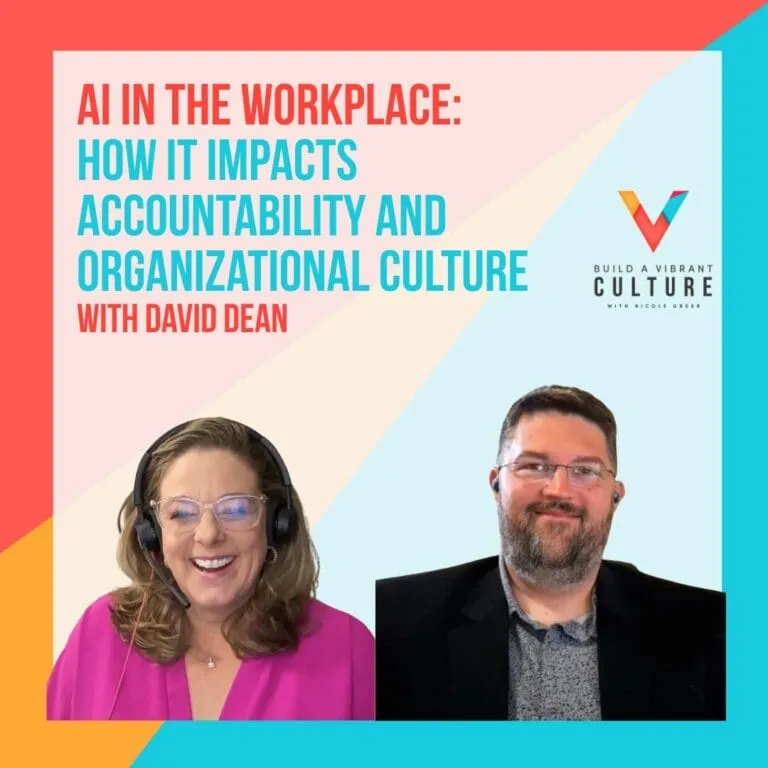
AI in the Workplace: How It Impacts Accountability and Organizational Culture with David Dean
Hosted by Nicole Greer
David Dean joins Nicole Greer on the Build a Vibrant Culture Podcast to discuss how AI reveals the gap between documented work and lived organizational reality, and why HR should help lead AI adoption through culture, trust, accountability, and employee experience.
Original episode
Listen or watch
Conversation summary
This conversation is aimed at HR, people strategy, and organizational culture leaders because those roles often see where formal policies, job descriptions, and stated values begin to separate from how employees actually experience the organization.
David and Nicole explore a core idea from An Inbox Between Us: AI does not simply change how people work. It helps reveal how work was already getting done through relationships, workarounds, hidden steps, judgment calls, and informal coordination.
The episode frames AI adoption as a cultural and behavioral strategy, not only a technology strategy. AI can help organizations examine communication patterns, authority, workload, trust, and psychological safety, but it will not automatically repair a dysfunctional organization.
Key insights
- HR and people strategy leaders are close to the lived experience of work, not only the documented version of work.
- AI can reveal the behavioral operating system that sits beneath formal policies, roles, processes, and stated values.
- Emails, meetings, messages, calendars, and transcripts can contain evidence of hidden coordination, workload, authority, trust, and psychological safety.
- AI should be introduced as a companion that creates breathing room for human judgment, learning, creativity, and problem-solving.
- Without organizational self-awareness, AI can industrialize dysfunction instead of helping the organization improve.
Questions answered
Why does this conversation matter for HR leaders?
HR leaders see both the official version of work and the employee experience of that work. That gives them a practical vantage point for noticing where culture, trust, workload, authority, and accountability are shaping outcomes.
What is the behavioral operating system of an organization?
It is the lived system of relationships, workarounds, hidden steps, informal decisions, and judgment calls that keep work moving beyond the documented operating model.
How can AI help organizations see their culture more clearly?
AI can help examine patterns in communication and collaboration data, making it easier to notice blind spots around communication, workload, trust, authority, psychological safety, and how work really moves.
Why should AI be introduced as a companion rather than a replacement?
People still need room to think, learn, exercise judgment, solve problems creatively, and use the lived experience they were hired for. AI should support those human capabilities instead of pretending they are disposable.
What risk appears when organizations adopt AI without self-awareness?
AI may scale the dysfunction already present. If leaders do not understand the human system the technology is entering, automation can amplify unclear ownership, weak trust, poor communication, and unhealthy cultural patterns.
Conversation guide
HR sees the lived reality of work
Why people, culture, and HR leaders are positioned to notice the gap between stated values and employee experience.
The behavioral operating system
How relationships, workarounds, hidden steps, and judgment calls keep organizations moving beyond the documented model.
AI reveals what was already happening
Why communication, meetings, messages, calendars, and transcripts can expose cultural and operational patterns.
AI as a companion
Introducing AI in a way that protects breathing room for human learning, creativity, judgment, and problem-solving.
Culture belongs in the AI strategy
Why trust, employee experience, and human behavior cannot be added after the technology strategy is complete.
Timecodes are omitted where the supplied transcript did not contain verifiable timing.
Edited transcript excerpts
Speaker labels and punctuation were reconstructed from automated transcription and edited for readability.
“There is the official contract, which is company values, standard operating procedures, and how the company generally operates.”
“The unofficial contract is really how the company actually runs behind the scenes.”
“All of the behavioral dynamics on how we get work actually done is living in that data.”
“The only way to truly change culture is self-realization.”
“Because it industrializes human behavior, it is only going to industrialize dysfunction in your organization even more.”
Keep exploring
Follow the idea without losing your place
Start with the closest connections. Open the additional links only when you want to go further.
Reading
Related articles
Source
Original episode
Continue the conversation
Explore the book behind these ideas, bring the conversation to an audience, or learn more about David’s work.